What After-Sales Support Looks Like for Brewery Machinery
The quotation is the easy part of buying brewery machinery; the years afterwards are where the cost sits. Support, spare parts and warranty terms decide how quickly a plant recovers from a failed pump or a leaking gasket. This article sets out what one manufacturer publishes about after-sales cover and turns it into a checklist a buyer can hold a supplier to.
Key takeaways
- Published service scope spans installation, commissioning, operator training, maintenance support and spare parts supply.
- Sales staff and engineers are described as online 24 hours, with 7x24 after-sales cover rather than office-hours only.
- The warranty runs 6 years on tank accessories and electronic components against manufacturing defects from the factory, used within scope.
- A spare-parts allowance of 1.5 per cent of capital spend is a reasonable planning figure, labelled here as an example.
What the published service scope covers
After-sales support starts before the first fault. A turnkey supplier of Hermann's kind typically carries the project through installation and commissioning, trains the operators who will run the plant, and stays available for maintenance questions and spare parts afterwards. That sequence matters because the training week is when most small breweries learn how their own vessels actually behave.
Ask for the scope in writing and separate it from the promise. Installation is a defined task with a defined end; commissioning is the day the first saleable beer comes out of the brewhouse; training is a number of days with named people. A supplier that lists those three items separately is easier to hold to a schedule than one that covers them with the phrase full support.
The 24-hour desk, and who actually answers
The published arrangement is that sales staff and engineers stay online 24 hours, backed by 7x24 after-sales service. In practice a buyer should test that commitment during commissioning, not during a crisis: call the number outside local office hours with a routine question and note how long a technical answer takes.
It also helps to know whom you are calling. A sales contact can price a replacement vessel; only an engineer can tell you whether the odd noise in the gearbox is a bearing or a pump that has lost its prime. Ask for the engineering contact at order stage and keep both numbers on the plant wall, next to the isolator.
Warranty: reading the six years properly
The warranty wording published by the manufacturer is specific: 6 years on tank accessories and electronic components against manufacturing defects from the factory, provided those parts are used within scope. That is a component warranty, not a promise that nothing will wear out, and the distinction matters when a seal fails after three years of daily cleaning.
Three questions turn the wording into something a maintenance planner can use. Which items are classed as tank accessories and electronic components? What counts as used within scope, particularly around cleaning chemicals and pressure limits? And what is the process for a claim: photographs, serial numbers, a replacement part shipped from the factory, or an engineer on site?
| Support item | Published arrangement | Confirm in writing |
|---|---|---|
| Installation | Included in the service scope | Days on site, who travels, who pays |
| Commissioning | Covered with technical support | The definition of a completed commissioning |
| Operator training | Part of the service range | Hours, trainees and a written checklist |
| Spare parts | Supply offered after delivery | Lead time for a common seal or valve |
| Warranty | 6 years on accessories and electronics | Claim route and what counts as in scope |
Spares: what belongs on the shelf from day one
Downtime is measured in batches, not in hours, which is why a modest spares shelf pays for itself early. The items that stop production are rarely exotic: pump seals, sight-glass gaskets, tri-clamp gaskets, a pressure-relief valve, a temperature probe and a set of hoses. None of them is expensive individually; all of them are expensive when a batch is waiting and the nearest supplier is on the other side of a shipping lane.
A sensible rule for a new plant is to stock one spare of every part that touches the product path on a daily basis, and to record the serial number of every vessel and panel so a replacement can be specified without a site visit. That record also supports any warranty discussion later, because the data plate ties a specific tank to its pressure test.
Worked example: budgeting support and spares
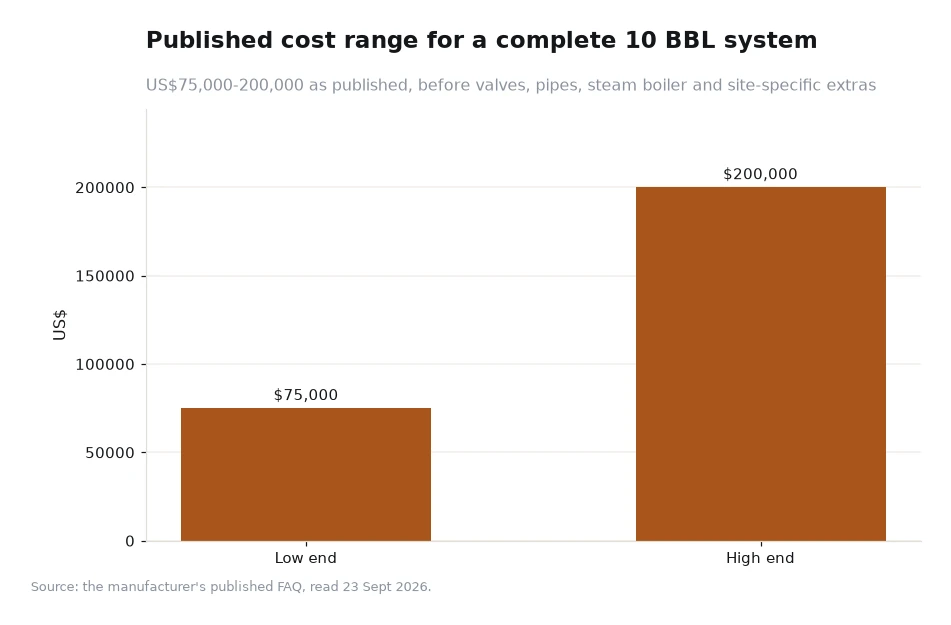
The arithmetic below is an example with the assumptions stated. Assume a capital spend inside the published 10 BBL range of US$75,000 to US$200,000, a spares allowance of 1.5 per cent of capital per year, and twelve brews a month at 10 BBL, which is about 1,170 litres per batch or roughly 14,040 litres a month.
At the low end, 1.5 per cent of US$75,000 is US$1,125 a year. At the high end, 1.5 per cent of US$200,000 is US$3,000 a year. Spread over twelve months that is US$94 to US$250 a month, which is less than the value of a single lost batch in most plans and is why the allowance is usually easy to justify on a spreadsheet.
Run the same numbers against downtime instead of parts. A five-day stoppage at 14,040 litres a month defers about 2,340 litres of production, assuming an even brewing rhythm and no catch-up capacity in the tanks. If the buffer vessel discussed in the tank schedule is available, part of that volume can be recovered; if not, it is simply gone. The exact figure depends on your own rhythm and fill level, but the comparison between US$94 a month of spares and a deferred 2,340 litres is the argument most owners find persuasive.
Frequently asked questions
Does the warranty cover wear parts like seals and gaskets?
The published wording covers tank accessories and electronic components for 6 years against manufacturing defects from the factory, used within scope. Consumable items that wear with normal use, such as soft gaskets and pump seals, are best treated as spares to hold on the shelf rather than as warranty items, whatever the supplier.
How quickly should I expect spare parts to arrive?
Delivery of the original order is published as 90-150 days from deposit to door. Spares travel the same route, so a common gasket ordered from the factory may take weeks rather than days. That lead time, not the part price, is the reason a starter spares kit belongs in the original purchase order.
Put the support terms in the order file
Before signing, assemble one page per support topic: installation days and who attends, commissioning criteria, training hours with named trainees, the spare parts list with lead times, and the warranty wording as published. That page is what you will read at eleven at night when something has stopped.
It is also worth checking that the after-sales promise reaches past the first year. The company profile describes 23 years of design work and installations in more than seventy countries, which is a reasonable proxy for the availability of parts and know-how in later years, and the equipment listings show which vessel families and panels are still in the catalogue. For anything that needs a person rather than a page, the contact page carries the direct route to the sales and engineering desk. If your maintenance plan needs a documented service and spares arrangement, this is the point at which hem brew system support terms should be quoted line by line rather than summarised.
Figures in this article come from the manufacturer's own website, read 23 Sept 2026, including the published 10 BBL cost range, the 6-year warranty wording, the 90-150 day delivery window and the 24-hour service arrangement; the spares allowance and downtime estimates are this article's own arithmetic with assumptions stated. Details: [1]