Slow Conversations vs Instant Gratification
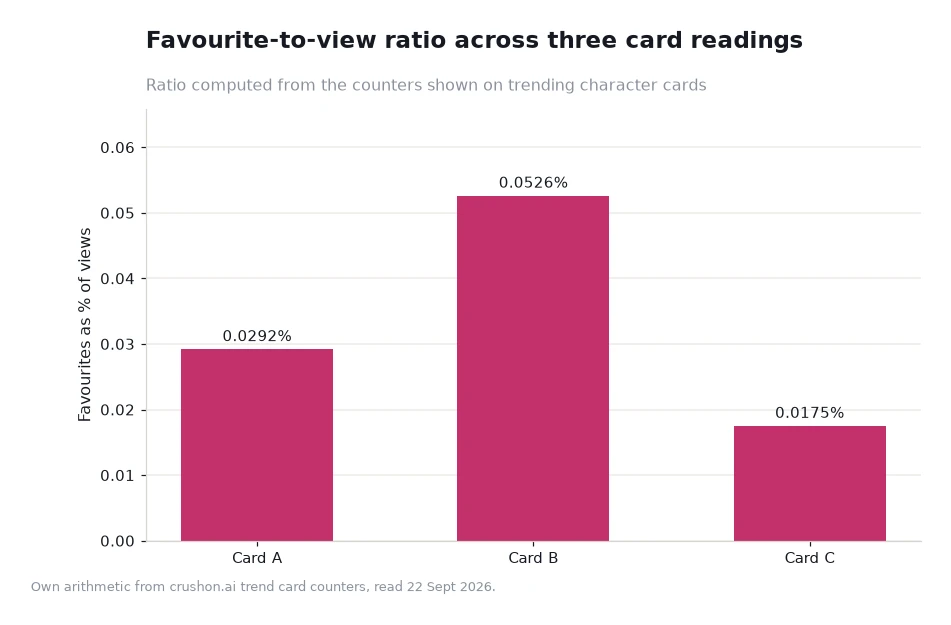
Adult chat platforms get used in two very different modes, and they cost roughly the same in attention while producing completely different experiences. The first is the fast mode: several short sessions a day, a few messages each, a fresh card every time. The second is the slow mode: fewer sessions, longer threads, the same character for weeks. The counter arithmetic hints at which mode a card was built for — a card saved 0.0292% of the time is being bookmarked, not skimmed.
Key takeaways
- Fast mode spreads attention across many cards; slow mode concentrates it on two or three threads that carry context forward.
- Time is the variable, not effort: ten sessions of six minutes a week is 60 minutes, three sessions of 30 minutes is 90.
- Crushon describes Sex AI companions that remember preferences and recall earlier interactions, which is a feature slow mode exploits and fast mode ignores.
- Save ratios between 0.0175% and 0.0526% suggest most visitors keep a card rather than consume it once.
What fast mode is good for
Fast mode is a sampling tool. Short sessions let you test five or six cards in the time a single long thread would take, and they answer one question well: does this setup give you something to respond to? If a card's opening three lines do not produce a reply you want to answer, no amount of session length will fix it.
Its weakness is that it never accumulates. A thread that runs for four messages has no register to settle into, so every session starts at the same shallow point. Over a week of fast sessions you may see twenty cards and remember none of them clearly.
What slow mode is good for
Slow mode is where continuity shows. When a thread runs to forty or fifty messages, the character's voice stabilises, earlier details stay in play, and the conversation begins to feel written rather than generated on demand. This is the mode the platform is designed around: characters that adapt to your personality, remember your preferences and recall previous interactions. That description also explains why ai sexting is better understood as a long-form activity than as a quick check, since adaptation needs time to appear and a session measured in minutes rarely shows it.
The cost is that slow mode is unforgiving about card choice. Committing thirty minutes to a card with a thin setup wastes all thirty; committing ten would have revealed the problem. The practical answer is to sample in fast mode and then switch, which is why the two modes are complements rather than rivals.
The time arithmetic
Take two weekly budgets of similar size. Fast mode: ten sessions of six minutes, which is 10 × 6 = 60 minutes a week. Slow mode: three sessions of 30 minutes, which is 3 × 30 = 90 minutes a week. Over four weeks that is 240 minutes against 360 minutes, or 4 hours against 6 hours.
Now look at what each produces. Forty short sessions in a month touch forty or more cards; twelve long sessions touch three or four. Neither is wasteful, but only one of them ends the month with a thread worth re-reading, and that is the trade the reader is actually making.
The session counts and durations are illustrative assumptions rather than platform data. What the arithmetic establishes is that the modes are close in total time and very far apart in outcome, so the choice is about what you want from the month, not about how much time you have.
| Measure | Fast mode | Slow mode | What changes |
|---|---|---|---|
| Session length | About six minutes | About 30 minutes | How much context accumulates |
| Sessions per week | Ten | Three | Breadth against depth |
| Cards touched monthly | Forty or more | Three or four | Sampling against continuity |
| Setup quality needed | Low | High | Slow mode punishes thin cards |
| Memory in play | Barely exercised | Central to the experience | Whether threads compound |
Worked example: reading the counters for mode
The card readings in the chart that follows sit at 0.0292%, 0.0526% and 0.0175%. Convert the first from counts to a rate: 7,100 saves divided by 24,300,000 views equals 0.000292, or 0.0292%. Divide the strongest reading by the weakest: 0.0526 ÷ 0.0175 ≈ 3.0, so the most-saved card in the set converts about three times as often as the least.
Those numbers are consistent with a slow-mode audience. A save is a decision to return, and a card that is saved rather than merely viewed is one that readers expect to come back to. If most engagement were instant, saves would be a rounding error on the view count rather than a ratio worth computing at all.
A second illustrative figure turns a mode into a plan. Sixty minutes a week divided into six-minute fast sessions gives ten slots; the same 60 minutes divided into 30-minute slow sessions gives two. Deciding which of those two shapes the week will take is the whole scheduling decision, and it costs nothing to make in advance.
Switching modes deliberately
The efficient pattern is a short sampling phase followed by a long commitment phase. Spend a fortnight in fast mode with a fixed opening sentence, keep the two cards that produced the best replies, and then move to slow mode with those two only. The sampling phase is cheap because it fails fast, and the commitment phase is where continuity pays for itself.
Two habits make the switch work. Keep a note of what you said in the first message of every sampled session, so you can compare replies on equal terms, and re-read the character's opening description before you commit 30 minutes to it, since the setup is what slow mode is going to lean on. The NSFW AI trends list is a reasonable place to find candidates for sampling, and the character search is where you go once you know which register you want to commit to.
One signal that a month has drifted is the number of half-finished threads sitting on the account. Two or three is normal behaviour; a dozen means the sampling phase never ended and the commitment phase never started.
Frequently asked questions
Which mode is better?
Fast mode is better for finding a card and slow mode is better for keeping one. Used together, the sampling phase costs a fortnight and the commitment phase is where the value accumulates.
Do I need longer sessions to get better replies?
You need more context, which usually means more messages rather than slower typing. Twenty messages in one session does more for continuity than sixty spread across a week.
Why do saves matter more than views?
Because a save is a deliberate decision to come back. On the readings here, saves run between 0.0175% and 0.0526% of views, which is a small share of a large number.
Is fast mode a waste of time?
Only if it never ends. Sampling is cheap and useful; sampling for a year is just browsing.
Pick a mode per month, not per mood
Decide at the start of a month whether it is a sampling month or a committing month, and set the session length accordingly. That single decision fixes how many cards you will touch, how much continuity you can expect, and what you will have at the end of the four weeks. Instant and slow are both legitimate; drifting between them without noticing is the only genuinely unproductive option.
Data and sources: trend card counters on the Crushon trends page[1], read 22 Sept 2026; ratios are own arithmetic on those counters and the session lengths are illustrated assumptions. This article is written for an adult readership aged 18+.