OEM and ODM are not two grades of the same service. OEM means you bring the formula and the manufacturer executes it; ODM means you choose from formulas the manufacturer already owns. That distinction decides who holds the intellectual property, who carries the registration burden, and how much development cost lands in your first purchase order. Most disputes in fragrance sourcing begin with this one word being used loosely.
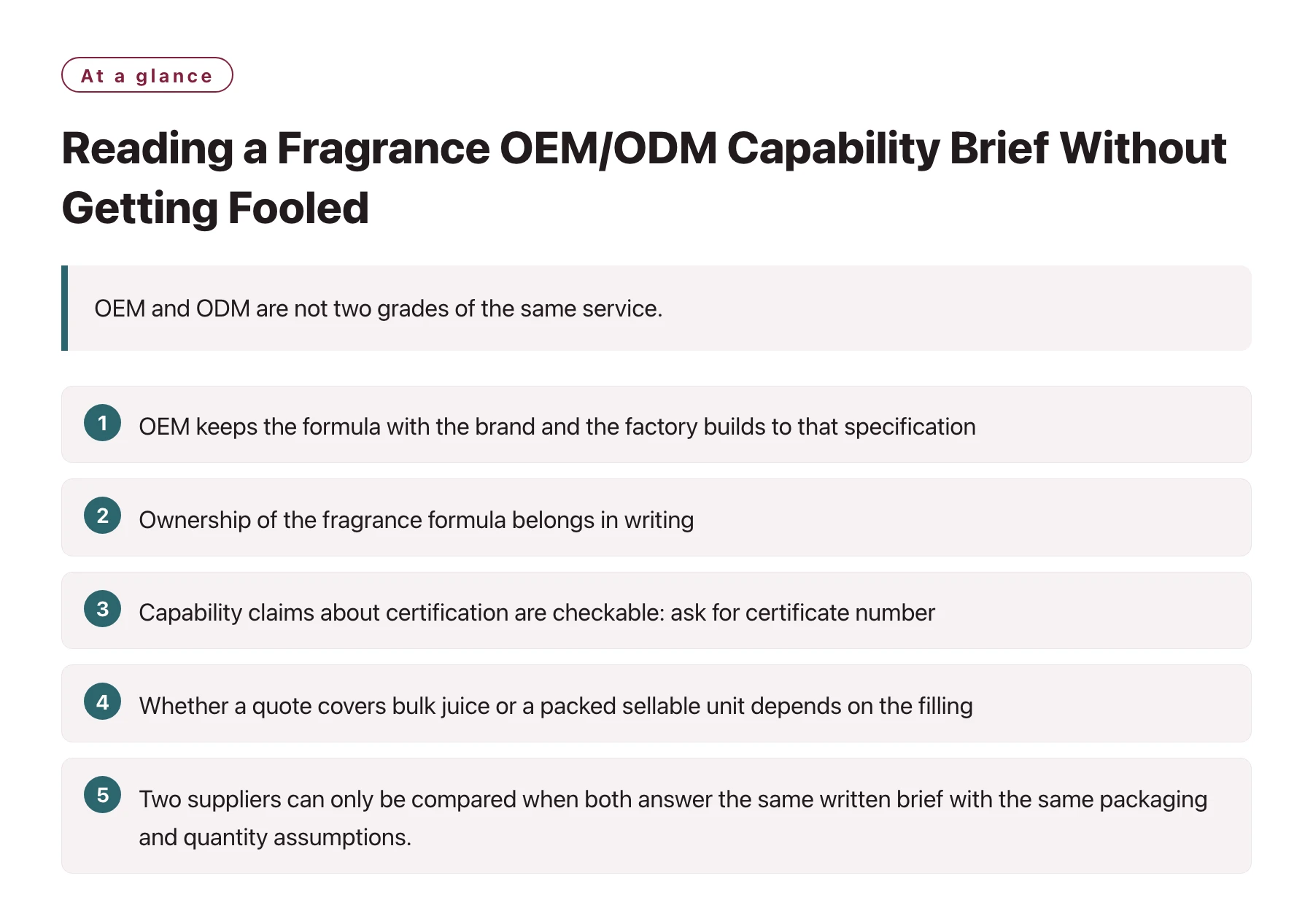
Key takeawaysOEM keeps the formula with the brand and the factory builds to that specification; ODM means the factory supplies a formula the brand licenses or buys outright. · Ownership of the fragrance formula belongs in writing, because it decides whether the same scent can be sold to another client in your market. · Capability claims about certification are checkable: ask for certificate number, scope and expiry rather than accepting a logo on a slide. · Whether a quote covers bulk juice or a packed sellable unit depends on the filling, crimping and packing lines behind it. · Two suppliers can only be compared when both answer the same written brief with the same packaging and quantity assumptions.
Sourcing conversations often start with a short message asking for a price per unit. That message will get an answer, but the answer rests on assumptions the buyer never saw and cannot compare against anything.
The OEM and ODM split is the first of those assumptions. It changes what the manufacturer is responsible for, what you pay for before the first bottle exists, and what you own afterwards.
This article covers what each model transfers, which capability claims can actually be verified, and how to write a brief that makes two suppliers answer the same question.
What OEM and ODM actually change in the contract
In OEM work the brand arrives with a settled formula and the factory takes it from there. In ODM work the factory presents a set of existing formulas and the brand selects, adjusts or licenses one. The words describe a direction of travel for the formula, not the size or skill of the factory.
The commercial consequences are larger than the wording. They touch ownership, exclusivity, development cost and how quickly a product can reach a shelf.
OEM: you bring the formula, they build it
Under OEM the brief is already answered before manufacturing starts. The factory's job is execution: sourcing materials to the approved specification, batching, filling, packing, and holding the batch documentation that supports the finished product.
Because the formula comes from outside, the factory cannot usually change it without your approval. That protects the scent but slows down problem solving if a raw material becomes hard to buy. Availability has a regulatory dimension too: the International Fragrance Association publishes standards that restrict how much of a given material may be used and in which product categories [3], so a formula can become awkward to source for reasons that have nothing to do with price. Under OEM that problem lands on your perfumer.
ODM: the formula comes from the manufacturer's library
ODM reverses the starting point. The factory opens its library, the brand narrows the field with samples, and the chosen formula may be used as it stands or adjusted within agreed limits.
Speed is the main advantage, since the development stage is short and the materials are already in the factory's purchasing system. The trade-off is exclusivity: unless it is negotiated, a library formula may be sold to other clients. This is the model most first-time brand owners actually use, whether or not they call it that. Manufacturers such as Xuelei in Guangzhou run both lines side by side, which is typical of factories that serve many small brands rather than one large account.
Where the line blurs, and why that matters
Real projects often sit between the two. A brand may start from an ODM base, pay for changes, and end up with something that feels bespoke but shares a skeleton with a scent still in the catalogue.
Manufacturers that run both models under one roof, including providers of fragrance OEM and ODM manufacturing services, will normally say which parts of a project are exclusive and which are shared. Ask for that in writing before samples are approved, because it is much harder to renegotiate once the artwork is finished.
Capability claims worth checking, and how to check them
| Claim you will hear | What it usually covers | How to verify it | Why it changes your decision |
|---|---|---|---|
| We are GMP certified | Good manufacturing practice for cosmetics, covering premises, hygiene and batch control | Ask for the certificate, its exact scope, the issuing body and the expiry date | GMP status affects whether the product can be placed in regulated markets at all |
| We handle compliance for you | Anything from basic safety documentation to full product notification support | Ask which markets, which documents, and who signs as the responsible person | Compliance work is easy to assume and expensive to retrofit after launch |
| We do bottles and cartons too | May mean in-house moulding, or simply sourcing from a third-party glassworks | Ask where each component is made and who holds the tooling | Tooling ownership decides how expensive it is to leave later |
| Full service from juice to pallet | Usually covers filling and packing, sometimes also labelling and retail assembly | Ask for a unit-by-unit list from bulk juice to packed carton | Any gap in that list becomes your own project management work |
| We hold ISO 22716 | The cosmetics good manufacturing practice standard that many fragrance makers are audited against [1] | Request the certificate number and confirm the scope covers your product category | An independent standard only helps if its scope matches what you are buying |
Read the third column as the real test. A claim becomes useful when it names a document, an issuing body and a scope, because those three things can be checked by someone who is not a perfumer. Claims that stay at the level of a slide are not dishonest; they are simply unverified.
How to write a capability brief that gets a usable answer
- State which model you wantSay whether you are bringing a formula, adapting one, or asking for a new development. Suppliers price these three situations very differently.
- Give a quantity ladderAsk for pricing at your launch volume and at two higher tiers, so you can see how setup and tooling costs amortise as volume grows.
- List every component, not just the juiceBottle, pump, cap, collar, label, carton and shipper each carry their own lead time and minimum order quantity.
- Name the target marketsSafety documentation and labelling follow the market of sale, so the compliance scope depends on where the product will ship.
- Work backwards from the shelf dateGive the launch date and let the supplier say which stages can be compressed and which cannot.
- Ask what is excludedExclusions reveal the real perimeter of a supplier's scope far better than the list of services on its home page.
Buyers often discover the OEM and ODM gap only when a second product line is planned and the first formula cannot be reused. If exclusivity was never discussed, the factory may be free to sell a very similar scent to another client in the same market. That is not a trick; it is the default when nothing was agreed. Settle exclusivity, territory and duration in the development agreement, not in a later email thread.
Comparing two quotes that were never really comparable
Once quotes are on the table, the differences are usually caused by the brief rather than by the factories. Two suppliers answering slightly different questions will produce numbers that cannot be lined up side by side.
Normalise quantity before comparing price
A unit price at ten thousand pieces and a unit price at three thousand pieces describe different businesses. Component tooling, printing plates and filling setup are spread across the run, so the smaller order carries more fixed cost per unit.
Ask both suppliers for the same three volumes and for the one-off costs listed separately. The comparison then becomes a table rather than an argument.
Keep development cost out of the unit price
Sampling, stability work and any regulatory documentation are development costs. When they are buried in the unit price, they disappear from the negotiation and reappear as a surprise if the project changes direction.
Separating them also makes it clear what you own if the project stops after sampling.
Confirm who owns artwork, tooling and the formula
Artwork files, moulds and the fragrance formula are three different assets with three different ownership questions. A quote rarely answers any of them.
Buyers entering a regulated market should also confirm who signs the product notification and safety documentation, since that role carries ongoing obligations after the launch [2]. Writing the names down at quotation stage prevents a difficult conversation later.
Sources
- SGS: Cosmetics, Personal Care & Household Testing —— Testing, inspection and certification services for cosmetics and personal care, including microbiological, stability and safety testing aligned with cosmetics GMP.
- European Commission: Cosmetics in the EU —— The European Commission's overview of EU cosmetics rules, including the responsible person, product information file and safety report requirements.
- IFRA Standards Library (International Fragrance Association) —— The IFRA Standards Library lists the restrictions the fragrance industry applies to individual fragrance ingredients, based on safety assessments; it is the reference point for compliant fragrance formulation.
Frequently asked questions
Is OEM cheaper than ODM for a first fragrance launch?
Usually the opposite for a first launch. OEM requires you to arrive with a finished formula, which means paying a perfumer separately before manufacturing is even quoted. ODM lets you start from an existing formula, so the development cost is lower, though exclusivity may cost extra.
Who owns the fragrance formula in an ODM project?
It depends entirely on the agreement. Many ODM formulas stay with the manufacturer and are licensed to the brand, sometimes with exclusivity limited to a market or a period. If ownership matters to you, it has to be written into the development contract rather than assumed.
What documents should I ask for when a supplier claims ISO 22716?
Ask for the certificate itself, the accredited issuing body, the scope of certification and the expiry date. Then check that the scope covers the product category you are buying. A certificate covering one site or one category does not automatically cover another.
Can one factory handle both OEM and ODM work?
Yes, and many do. The practical question is not whether they can, but how they keep the two apart. Ask how they prevent a formula developed for one client from being reused for another, and ask for that answer in the contract.
How long should a capability brief be?
Two pages is usually enough. One page for the product, the target markets, the packaging list and the quantity ladder; one page for the timeline and the questions you want answered. Longer briefs tend to hide the few decisions that actually drive the quote.