Battery Warranty Terms Worth Comparing
The number that should decide a battery warranty argument is not the headline year count but the capacity floor written underneath it. XPENG publishes a key parts term of 8 years or 160,000 km covering the traction battery, battery management system, drive motor and intelligent power unit, with a minimum of 70 per cent of the battery's original capacity during that period. Read the two together and you know what you are actually buying.

Key takeaways
- Key parts cover runs 8 years or 160,000 km, whichever occurs first.
- Within that period the traction battery is warranted to a minimum of 70 per cent of original capacity.
- Gradual capacity reduction is described in the published terms as normal for traction batteries.
- Cover applies to vehicles imported into Australia by XPENG's local operation and registered in Australia.
The warranty numbers worth writing down
Five published terms sit behind the car in the driveway. Whole vehicle cover is 7 years with unlimited kilometres for private use, and 7 years or 160,000 km for commercial use, whichever occurs first. Key parts cover is longer at 8 years or 160,000 km. Paint is covered for 5 years and anti-corrosion for 7 years, both with unlimited kilometres.
Read as a set, those numbers describe a car whose body protection, general cover and drivetrain protection expire at different times. Comparing two cars on the years alone tells you very little until you line up what each year covers and what condition is attached to it.
The honest caveat is that all of it is conditional. Conditions and exclusions sit in the XPENG ANZ Warranty and Maintenance Manual for Australia, and that document, not a brochure, is the one that decides a claim.
What the 70 per cent floor actually protects
A capacity floor is a promise about degradation, not about range. The published term says the traction battery provides a minimum of 70 per cent of its original capacity during the key parts period, which is a statement you can test only against a measurement rather than a morning's driving.
It also comes with a qualification that is stated plainly on the site: gradual capacity reduction is normal for traction batteries. Any electric car loses some usable capacity over years and kilometres, and the warranty defines the line below which that becomes the manufacturer's problem.
Practically, the floor is what protects a second or third owner as much as the first. A car at year six with a documented service history, an intact warranty record and capacity above the line is worth meaningfully more than an identical car without those things.
Published cover, item by item
| Cover | Published term | What it reaches |
|---|---|---|
| Whole vehicle, private use | 7 years, unlimited kilometres | Defects in the vehicle under the published terms |
| Whole vehicle, commercial use | 7 years or 160,000 km | The same cover, with a distance limit attached |
| Key parts | 8 years or 160,000 km | Traction battery, battery management system, drive motor and power unit |
| Traction battery capacity | Minimum 70 per cent during the key parts period | Capacity floor, with gradual reduction described as normal |
| Paint | 5 years, unlimited kilometres | Paint defects under the published conditions |
| Anti-corrosion | 7 years, unlimited kilometres | Corrosion cover for the body |
Conditions that keep a claim straightforward
The first condition is who imported the car. The published terms apply to vehicles imported into Australia by XPENG's local operation and registered in Australia, which is a sentence worth reading carefully if you are considering a private import.
The second is the service record. Scheduled maintenance is every 12 months or 20,000 km, whichever comes first, and the site recommends servicing through an XPENG Authorised Dealer. A stamped record is the strongest evidence a warranty claim ever has.
The third is documentation. Owner services include the XPENG Owner's App for scheduling maintenance and services, and remote diagnostics is standard equipment that can sometimes resolve an issue without a workshop visit. Keep the app history and keep the paperwork, because a claim is a conversation about evidence.
Finally, know who to call. Support is provided directly by XPENG ANZ, and customers who bought through TrueEV are directed to XPENG ANZ support. Roadside assistance runs for 7 years from first registration, with the published contact number 1800 255 494 and 24/7 coverage of the majority of Australia.
Worked example: distance against the 160,000 km term
This is illustrative arithmetic built on one published input, the key parts term of 8 years or 160,000 km, whichever occurs first. The annual distances are assumptions.
At 20,000 km a year, 8 x 20,000 = 160,000 km exactly. The term and the distance limit run out together, at the end of year eight, so a driver on that average uses the whole window.
At 25,000 km a year, 8 x 25,000 = 200,000 km, which is 200,000 minus 160,000 = 40,000 km beyond the limit. The term therefore ends on distance rather than time, at 160,000 divided by 25,000 = 6.4 years, or roughly six years and five months.
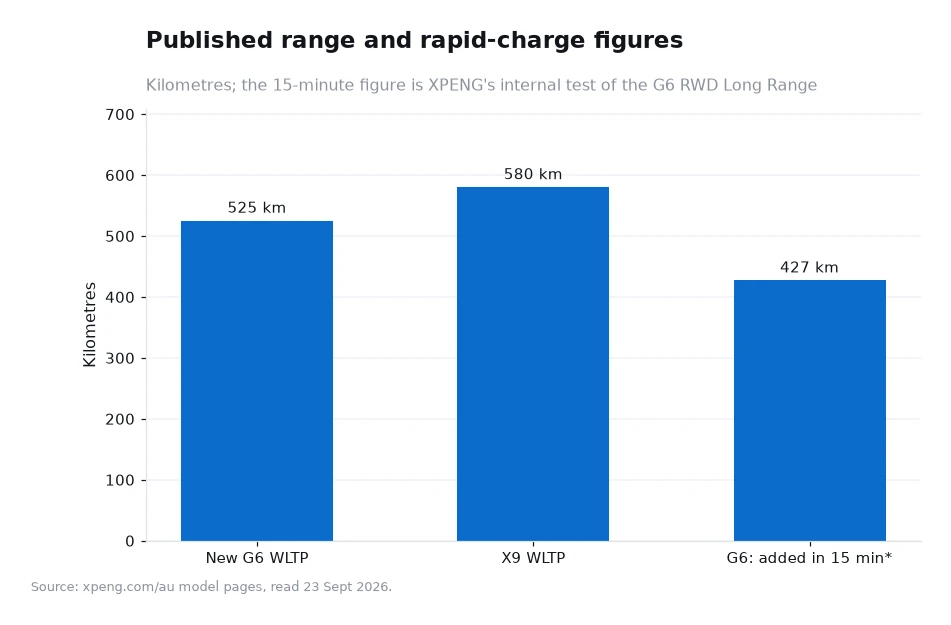
At 15,000 km a year, the same eight years is 8 x 15,000 = 120,000 km, leaving 160,000 minus 120,000 = 40,000 km of headroom. And to see what the capacity floor looks like in range terms, use the published WLTP ceiling of up to 525 km for the New G6: 70 per cent of 525 is 0.7 x 525 = 367.5 km, so a pack sitting exactly on the floor would correspond to roughly 368 km on the same test. That comparison is illustrative only, since the warranty is expressed as capacity, not range, and WLTP figures depend on conditions.
Why the charging terms belong in the same conversation
A battery warranty is only half the story of living with the car. The other half is how often you charge and how fast. The published rapid-charge window is 10 to 80 per cent state of charge in 12 minutes on the 5C battery, and the site's 15-minute figure of 427 km comes from an internal test of the G6 RWD Long Range.
Those numbers matter to a warranty discussion because they describe how the pack is meant to be used. Frequent rapid charging is a normal part of modern electric motoring, and the published maintenance schedule is the framework the manufacturer expects owners to follow.
Frequently asked questions
What does the 70 per cent battery capacity floor mean?
The published key parts term states that the traction battery provides a minimum of 70 per cent of its original capacity during the 8 year or 160,000 km key parts period, with gradual capacity reduction described as normal for traction batteries.
Does the battery warranty transfer to a second owner?
The published terms apply to vehicles imported into Australia by XPENG's local operation and registered in Australia, and they run from first registration for the periods stated. Ask a dealer to confirm exactly how the record transfers for the specific car you are buying.
What to ask before you sign
Take three questions to the dealership. Which parts does the key parts term cover on this exact variant, how is a capacity claim assessed and by whom, and what maintenance evidence do I need to keep. Ask for the answers in writing with your formal quote, since there is no published Australian pricing and the quote is where the detail is confirmed.
Then read the warranty overview yourself before the appointment and check the published service schedule on the service page. The specification behind the capacity figure sits with the model detail for the XPENG electric suv australia range on the manufacturer's own site.
Warranty and service terms in this article come from the manufacturer's Australian site at xpeng.com/au, read on 23 Sept 2026, and conditions and exclusions are set out in the XPENG ANZ Warranty and Maintenance Manual for Australia. The annual distances and the capacity-to-range comparison are the author's own illustrative arithmetic. [1]